Mobile Asphalt Plant Environmental Compliance and Emission Control Guide
Release Time:2026-08-12
Read:
Share:
Mobile asphalt mixing station is widely used in various infrastructure projects by virtue of its advantages of rapid transfer and local production. However, compared with fixed equipment, it is easy to cause pollution problems such as dust, asphalt flue gas, nitrogen oxides and rainwater runoff due to its characteristics of cross-regional construction, temporary site operation and easy disassembly. At present, environmental protection supervision is becoming stricter and stricter. Mobile asphalt station will face risks such as fines, shutdown and limited qualification if it fails to meet environmental protection standards. Many construction enterprises are faced with problems such as excessive transfer, dust suppression difficulties and equipment vulnerability all the year round. In combination with industry control standards and practical operation experience, this paper comprehensively disassembles the key points of environmental protection compliance, pollution control, equipment operation and maintenance and type selection of mobile asphalt station, providing professional practical operation reference for industry practitioners.
Why Environmental Compliance Matters in Asphalt Plants
Environmental compliance is the basic threshold for continuous production of mobile asphalt stations
Mobile asphalt mixing station will continuously generate various controlled pollutants in the whole process of aggregate drying, asphalt mixing and raw material transfer. Particulate matter PM10/PM2.5, nitrogen oxide NOx, carbon monoxide CO, sulfur dioxide SO ˇ, asphalt VOCs, polycyclic aromatic hydrocarbons PAHs, unstructured dust, peculiar smell noise and rainwater sediment runoff are all included in the territorial normalization supervision. The US NSPS industrial furnace standard, Domestic Comprehensive Emission Standard for Atmospheric Pollutants GB16297, Control Standard for Unorganized Emission of Volatile Organic Compounds GB37822 and Emission Standard for Pollutants in Asphalt Industry all set clear emission limits for asphalt mixing facilities. The emission limit of particulate matter in key areas is as low as 10mg/m³, and the transparency (blackness) of flue gas is controlled within 20%.
For mobile equipment, environmental compliance is no longer an additional work, but a rigid production premise, and multiple losses caused by violations directly affect project profits:
Legal and production risks: For each replacement of a construction site of mobile station, temporary environmental impact assessment filing and temporary emission permit filing shall be completed. If the mobile station is put into operation without going through formalities, the administrative penalty of Ecological Environment Bureau will be triggered if the emission exceeds the standard, including daily penalty, shutdown and rectification of the whole line, and withdrawal of project construction permit in serious cases; bag damage, flue leakage and lack of organized dust control are the most common punishment points for on-site inspection.
Residents 'complaints and social operation risks: mobile mixing stations are mostly arranged in temporary sites around towns and villages. Untreated asphalt blue smoke and dust odor are easy to cause complaints from surrounding people. After receiving complaints, the supervision department will expedite on-site inspection, greatly reduce the effective production time of equipment, damage the reputation of enterprise construction, and lose the bidding qualification for subsequent municipal and highway projects, which is often called "social operation license" in the industry.
Occupational health and safety production value: The perfect environmental protection treatment system can greatly reduce the concentration of dust and toxic asphalt smoke in the workshop and unloading area, and reduce the risk of respiratory tract diseases and skin irritation of operators; the low nitrogen combustion and closed gas collection system can avoid the accumulation of carbon monoxide generated by incomplete combustion and eliminate the potential safety hazards of explosion and poisoning in the factory.
Cost reduction, efficiency enhancement and sustainable benefits: The compliant bag dust removal system can collect ultra-fine mineral powder and recycle it into the mixing tank, reducing the amount of purchased mineral powder; warm asphalt and low nitrogen gas burners reduce fuel consumption, reduce carbon dioxide greenhouse gas emissions, meet the requirements of green construction and low carbon highway bidding, and extend the service life of filter bags and drying rollers, reducing frequent maintenance and replacement costs.
Differences in environmental control between mobile asphalt stations and fixed stations
For the same set of environmental emission standards, the implementation difficulty of mobile mixing station is much higher than that of fixed station, and the core difference is concentrated in four scene pain points:
Multi-territorial policies are not unified: trans-provincial and cross-city and county transfer construction, temporary pollution discharge filing process, particulate matter, VOCs control standards and equipment isolation distance requirements in each region are obviously different. Some counties require mixing stations to be no less than 1km away from residential areas, and only 300m isolation belts are set in some areas. If the territorial rules are not verified in advance, the equipment cannot be put into operation after mobilization.
Transfer disassembly destroys environmental sealing:each time the bag dust removal flue, closed conveyor belt and asphalt flue gas collection pipeline are disassembled and transported, joint air leakage and flange gasket falling off are easy to occur. After transfer, the machine is directly started without comprehensive leak detection, and there is no organized dust and flue gas directly exceeds the standard. This is the main cause for exceeding the standard on site of the mobile station.
The supporting conditions of temporary site are weak: the fixed station plant area is fully hardened and equipped with complete rainwater precipitation and enclosure spraying system; while the temporary construction site is mostly wasteland and dirt road, the raw material stacking area has no windproof enclosure, the transportation road is not hardened, a large amount of secondary unstructured dust is generated by vehicle traffic, and the silt-containing wastewater is directly discharged due to rainwater washing aggregate pile, which violates the requirements for rainwater runoff control.
Flexible fluctuation of production scale: the mobile station adjusts the production capacity at any time according to the project progress. The combustion condition of the burner is unstable during low-load production, which is easy to produce incomplete combustion flue gas and asphalt blue smoke; the dust concentration rises sharply during the production of high-content recycled RAP materials, and the load of conventional dust removal system is insufficient, resulting in excessive emission.
In order to realize long-term stable compliance operation, it is necessary to establish a full-process management and control system for mobile device specific pain points, and implement environmental protection measures synchronously from equipment hardware, on-site management, operation and maintenance inspection and transition reporting.
Key Environmental Emissions from Mobile Asphalt Plants
The production process flow of mobile asphalt station includes six links: cold aggregate loading, drying and heating, screening and transportation, asphalt mixing, finished material unloading and recycled asphalt RAP blending. Pollutants are divided into two categories:organized flue emission pollutants andunorganized emission pollutants. The sources, hazards and control priorities of different pollutants are clearly distinguished:
Organised flue gas
Particulate matter PM, PM10 and PM2.5are mainly produced in aggregate drying and screening procedures. Under uncontrolled conditions, the dust concentration can reach 30g/Nm³, including coarse sand powder and ultrafine inhalable dust, which is the primary control index for environmental protection monitoring; The removal efficiency of mobile standard bag filter shall be stable above 99%, the outlet particulate matter shall be controlled within 20mg/m³, and the strict limit of 10mg/m³ shall be implemented in key areas of Beijing-Tianjin-Hebei and Yangtze River Delta.
Combustion gaseous pollutants NOx, CO, SO ˇ, CO ˇare generated by fuel combustion of drying drum burner: nitrogen oxide NOx is generated by high temperature flame, carbon monoxide CO is generated by incomplete combustion of fuel oil, sulfur dioxide SO ˇ is released by heavy oil and waste oil fuel; natural gas and propane clean energy can greatly reduce sulfur emission, and low nitrogen burner can reduce nitrogen oxide output by more than 60%. Carbon dioxide as greenhouse gas, warm mixing process, high blending of recycled materials are the core means of source emission reduction.
Asphalt flue gas, VOCs, blue smoke and toxic HAPs release volatile organic compounds during heating, mixing and unloading of asphalt binder at high temperature. The visible "blue smoke" is condensed organic aerosol, and the transparency exceeds 20%. The flue gas contains trace harmful air pollutants such as benzene, toluene, polycyclic aromatic hydrocarbons, formaldehyde, etc., which are harmful to the surrounding ecology and human settlements for a long time. The high-configuration mobile station is equipped with flue gas reburning and activated carbon adsorption devices to achieve advanced treatment.
No tissue emission pollutants
Dust from material transportation: loading of cold storage bin, transfer of conveyor belt, loading and unloading of finished materials, open storage of aggregates, secondary dust generated by dirt road driving of transportation vehicles in the plant area, no on-line monitoring of unorganized dust, supervision personnel can quickly determine the exceeding standard with naked eyes and handheld detectors on site.
Odor and emission of asphalt flue gas: asphalt storage tank, mixing tank discharge port is not sealed, negative pressure gas collection system is missing, high temperature asphalt flue gas is directly dispersed, residential areas close to the site is easy to cause odor complaints.
Noise pollution: drying fans, burners, screening equipment, transport trucks superimposed noise, night construction needs to be equipped with noise barriers, to meet the noise emission standards at the plant boundary.
Rainwater runoff pollutants: open aggregate piles and equipment washing produce sewage containing sediment and asphalt. Direct discharge without sedimentation tank will pollute surrounding ditches and cultivated land. Temporary cofferdams and multi-stage sedimentation tanks shall be provided.
Overall control priority: bag-type dust removal particulate matter treatment> burner flue gas source emission reduction> unorganized closed dust suppression> asphalt VOCs flue gas deep treatment> site rainwater, noise control, mobile station environmental protection equipment configuration, daily inspection are designed around this priority.
Major Environmental Control Systems on a Mobile Asphalt Plant
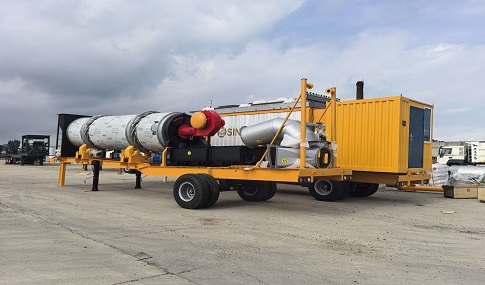
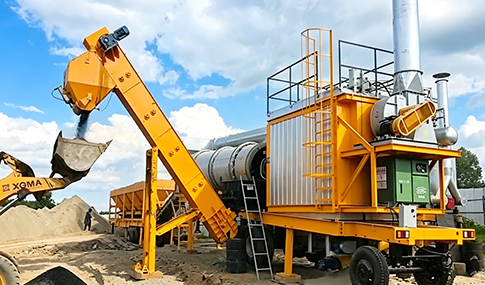
To meet the needs of mobile equipment hauling and rapid disassembly, the whole set of environmental protection system adopts modular trailer integrated design, which can be quickly assembled without large crane. The whole set of treatment unit is divided into five modules: pre-dust removal, main bag dust removal, combustion exhaust gas optimization, unorganized closed dust suppression and asphalt flue gas deep purification. Each set of system is targeted optimization for mobile scenarios:
Bag filter
Bag dust collector is the decisive equipment for mobile asphalt station to meet the emission standard. Almost all temporary discharge permits require the configuration of efficient bag dust collector. Pulse blowing ash cleaning structure is adopted in the mainstream. It is equipped with high temperature resistant aramid Nomex filter bag. It can withstand high temperature flue gas of 140-180℃ for a long time. Instantaneous temperature resistance is 200℃. It is resistant to asphalt soot adhesion and acid corrosion of flue gas.
Equipment structure and mobile exclusive design Integral dust removal box, induced draft fan, ash hopper powder recovery screw conveyor integrated in the independent trailer chassis, the overall locking fixed during transportation, no need to disassemble; flue with fast-mounting flange sealing structure, after the transition completed within 1 hour pipeline docking; The box interior set up compartment pulse ash, equipped with pressure difference online monitoring instrument, real-time display filter bag blockage degree, avoid manual repeated cover detection.
A gravity cyclone separator is added upstream of the pre-cyclone pre-dust collection bag to separate 85%-90% coarse aggregate dust first, greatly reduce the filter load of the bag, prolong the service life of the filter bag, separate coarse powder and directly convey it back to the production system in a spiral way, realize the resource utilization of waste materials, and reduce the cost of solid waste transportation and disposal.
The core control indicators of operationare normal operation, the pressure difference is stable and maintained at 2-7 inches of water column, the continuous increase of pressure difference indicates that the filter bag is blocked, and the sudden drop of pressure difference indicates that the filter bag is damaged and leaked; the compressed air system is equipped with a drying and degreasing device to prevent the wet oil and gas from adhering to the filter bag and causing the paste bag to be scrapped; the box must be preheated before the equipment is started, and the internal temperature must be raised to above the acid dew point to avoid the flue gas condensation corrosion of the filter material.
Low nitrogen multifuel burner system
Dry drum burner is the source of exhaust gas generation, optimize combustion conditions, select clean fuel, can greatly reduce pollutant output from the front end of production, lower investment than terminal treatment, more stable emission reduction effect, adapt to mobile station multi-site fuel supply differences, mainstream multi-fuel compatible low nitrogen burner:
Comparison of fuel type emission difference Naturalgas and liquefied propane are the best clean fuels, sulfur dioxide emission is almost zero, nitrogen oxide output is extremely low, suitable for Urban area and township close distance construction;0#diesel oil is second; waste oil and heavy oil have low cost, but sulfur content is high, which will accelerate filter bag corrosion. They are only used in remote and gas-free sites for a short time, and anti-corrosion maintenance of bags needs to be strengthened.
The core technology of low nitrogen combustionadopts three technologies: staged combustion, flue gas recirculation FGR and electronic precise air-fuel ratio control to avoid local ultra-high temperature generation of nitrogen oxides; full-automatic PLC system adjusts the proportion of air intake and oil intake in real time to eliminate incomplete combustion of fuel and eliminate yellow smoke and black smoke; supporting roller insulation layer to reduce heat loss, reduce fuel consumption and simultaneously reduce carbon dioxide emissions.
The warm mix asphalt is matched with theburner linkage warm mix addition system, the mixture production temperature is reduced by 30-50℃, the total amount of volatile VOCs in asphalt is directly reduced, the blackness of flue gas is reduced, and the processing load of bag and flue gas purification equipment is greatly reduced. It is the core process means for low cost emission reduction of mobile stations.
Organization-free dust control system
In view of the dust problem caused by frequent material transfer in the open-air site of mobile station, the whole set of closed dust suppression facilities is modular and can be quickly disassembled, including: fully enclosed cold material conveyor belt, flexible dust seal cover at transfer point, mobile spray fog gun system in stacking area, vehicle washing platform in plant area, temporary windproof enclosure and hardened dust suppression road.
Cold storage bin and screening machine shall be sealed under negative pressure in the whole process. Dust collection branch pipes shall be installed at all material drop transfer points to uniformly collect and collect unorganized dust into main bag dust collector; temporary dirt road shall be watered regularly, gravel shall be laid to suppress dust, and tires shall be washed compulsorily when vehicles leave the site to prevent dust on the road with mud; the aggregate stacking area shall be fully covered with rain-proof dust suppression tarpaulin to reduce dust generated by wind.
Asphalt blue smoke and VOCs deep purification device
Mobile stations constructed around schools, villages and drinking water sources cannot meet VOCs and odor control requirements only by bag dust removal. Secondary deep purification equipment shall be installed. There are two mature schemes:
Flue gas reburning system: organic flue gas collected by mixing cylinder and asphalt storage tank is led into drying drum burner, VOCs and asphalt tar are fully decomposed at high temperature, no secondary hazardous waste is generated, and the operation and maintenance cost is the lowest. It is the preferred scheme for mobile stations.
Electric tar catcher + activated carbon adsorption combination: the flue gas first captures asphalt oil mist through electric precipitation, and then adsorbs residual organic matters through activated carbon, with a treatment efficiency of more than 95%. It is suitable for Urban area projects with extremely strict environmental protection standards. It is necessary to replace activated carbon hazardous waste regularly and dispose in compliance with regulations.
It includes variable frequency induced draft fan, high height standard exhaust pipe, multi-stage rainwater sedimentation tank, noise insulation and noise reduction barrier, hazardous waste storage tank and automatic production data recording system, which are used to meet the full-dimensional compliance requirements of sewage filing account, rainwater management control, noise control and hazardous waste management.
Practical operation scheme for fine dust pollution control of mobile asphalt mixing station
Dust is the primary verification item for mobile station environmental protection inspection, including organized dust in the flue and unorganized dust on the site. It needs to be coordinated and controlled by combining the three methods of equipment operation and maintenance, on-site management, and production operation to form a standardized operating process:
Long-term control of flue organized dust
Before starting the equipmentevery day, the inspection process operator shall check the pressure difference value of the bag, the working state of the pulse ash cleaning solenoid valve, the operation condition of the ash hopper screw conveying equipment, and whether the flue flange sealing gasket is broken; observe that there is no visible smoke in the exhaust stack before putting it into production; once white smoke and ash smoke appear, stop the machine immediately to check the damage point of the filter bag.
Regular filter bag maintenance and replacement specifications Open the access opening every week to check the scale and damage on the filter bag surface; replace the filter bag as a whole in 2 - 3 years under heavy oil and high moisture aggregate conditions, and extend the gas clean condition to 4 - 5 years; complete the pulse ash cleaning procedure after shutdown to remove dust caking on the filter bag surface and avoid long-term paste bag blockage.
Special leakage detection process for transfer:After each equipment disassembly and transfer is completed, direct production is prohibited. The whole dust removal system shall be operated for 30 minutes without load. Check whether there is air leakage and dust leakage at the sealing positions of flue, box body and access door section by section. After all sealing and reinforcement, the mixture shall be put into production.
Full scene control measures for unorganized dust in temporary sites
Raw material stockpiling control: all sand, mineral powder and recycled RAP materials are stacked in different areas, covered with rain-proof and dust-suppressing tarpaulin, the height of stacking materials is reduced, the drop of materials is reduced, and spraying water mist is started to suppress dust synchronously when unloading;
Closed control of transfer channel: all belt conveyors are equipped with fully enclosed dust covers, and negative pressure air collectors are set at the transfer points to prevent dust overflow during transfer;
Dust control of roads in the plant area: all the transportation roads in the plant are paved with gravel or sprayed regularly to keep moisture, the speed of trucks is limited to less than 5km/h, the vehicle washing platform is fixed at the entrance and exit, and the precipitation water is circulated and sprayed;
Shutdown dust suppression management: after daily production, sprinkle water on bare soil surface and stacking area comprehensively, increase spraying frequency in windy weather to avoid wind dust diffusion at night.
Dust reduction means at the source of production process
Reasonable control of aggregate drying moisture content, moisture content is too high will greatly increase the amount of dust, drying aggregate in advance to reduce drying load; optimize the drying drum curtain structure, stepped lifting blades form uniform curtain, improve heat exchange efficiency, reduce ultrafine dust generation; high mixing recycled materials production, synchronous increase the air volume of bag induced draft fan, matching dust concentration fluctuation.
Fuel and Burner Management for Lower Emissions
Fuel selection and combustion condition management are the most economical means for mobile mixing stations to achieve low nitrogen, low sulfur and low VOCs emissions. Without greatly increasing equipment investment, the risk of flue gas detection exceeding the standard can be significantly reduced only through operation and maintenance optimization, and flexible switching of fuel supply for multiple sites can be adapted:
Suggestions for adaptation of different fuel emission characteristics to mobile scenarios
The comprehensive emission of natural gas and liquefied propane is optimal, SO 2 is almost zero emission, NOx and CO output is much lower than that of oil, and priority is given to projects around urban suburbs and residential areas; 0#light diesel oil can be used in remote mountainous areas without gas supply, and long-term use of high-sulfur waste oil is strictly prohibited. If waste oil is temporarily used, it shall be filtered in advance to remove water, and bag anti-corrosion coating shall be added to shorten the replacement cycle of filter bags.
From the long-term compliance cost calculation, the fuel consumption cost of gas burner is lower, the maintenance expenditure of bag and flue corrosion is reduced, and the annual flue gas detection and rectification cost is reduced. The comprehensive income is significantly higher than that of heavy oil fuel.
Key points of fine operation and maintenance optimization of burner
Electronic air-fuel ratio regular calibration: monthly calibration burner oil-gas/gas-gas ratio sensor, air excess coefficient control in a reasonable range, too little air will produce incomplete combustion blue smoke, carbon monoxide exceeds the standard, excessive air will increase flame temperature, nitrogen oxide concentration increases;
Drying drum insulation and process temperature control: complete insulation rock wool is installed on the outer layer of the drum to reduce heat loss. On the premise of meeting the qualified temperature of the mixture, warm mixing technology is adopted to reduce the heating temperature and reduce VOCs volatilized from asphalt;
Equipment load matching adjustment: reduce burner power during low output construction, avoid low fire and high temperature conditions, stabilize flame shape and inhibit NOx generation;
Regularly clean the combustion nozzle: the fuel burner nozzle is easy to coke and block, and it is disassembled and cleaned every month to prevent partial incomplete combustion caused by uneven fuel injection and visible black smoke.
Supporting auxiliary measures for energy conservation and emission reduction
Optimize the moisture content of aggregate feed, reduce the total amount of fuel required for drying; the waste heat of the drum can be recycled for asphalt tank insulation; select variable frequency fans to match the production load, reduce the overall power consumption of the equipment, indirectly reduce carbon emissions on the power generation side, and meet the green construction evaluation standards.
Environmental Compliance Requirements for Mobile Asphalt Plant Installation
Mobile station mobilization and construction is not equal to direct production. It must complete four links: territorial filing, site compliance verification, installation and commissioning of environmental protection equipment and initial emission detection. Missing any process belongs to illegal production. The complete standardized construction compliance steps are as follows:
Handling environmental protection procedures in the early stage
Verify the environmental protection policy of the construction territory, confirm the isolation distance, capacity limit and fuel control requirements of the temporary mixing station;
Submit temporary filing of mobile pollution source and application form for temporary emission permit, accompanied by equipment environmental protection parameters, bag dust collector and low nitrogen burner test report;
Sensitive areas (water sources, villages and towns, schools) shall be additionally submitted to the public for publicity, and some areas shall require a simplified version of the third-party environmental assessment;
If waste engine oil and hazardous chemical fuel are used, the hazardous waste management and storage filing procedures shall be completed simultaneously.
In most areas, equipment transfer is required to submit filing materials 10-20 working days in advance, and direct mobilization without filing in advance will be ordered to dismantle the equipment immediately.
Site selection and environmental protection supporting construction specifications
The site selection shall give priority to avoiding the upwind direction of drinking water protection area, residential area and cultivated forest land, and strictly abide by the local minimum isolation distance; after site leveling, complete the zoning hardening: the mixing main engine area, asphalt tank area and hazardous waste storage area shall be fully impervious and hardened, and the exposed soil surface shall be paved with dustproof net; the rainwater multi-stage sedimentation tank, vehicle washing platform, windproof enclosure and spraying dust suppression system shall be constructed simultaneously, and the main engine equipment shall be hoisted only after all environmental protection supporting facilities are qualified.
Installation, sealing and no-load commissioning of environmental protection equipment
After the main engine, bag dust collector, burner and flue gas purification system are all hoisted in place, complete the quick installation flue sealing and negative pressure gas collection pipeline docking, and check the integrity of all flanges and access door gaskets; the whole set of environmental protection equipment and production equipment shall be interlocked, and the main engine cannot be started when the dust collection system is not started; no-load trial operation shall be conducted for 2-4 hours, and the bag pressure difference, induced draft fan air volume, combustion condition and flue gas recovery system operation state shall be detected to handle all leakage and abnormal working condition problems.
Emission detection before production and establishment of account system
After the no-load commissioning of the equipment is completed, a third-party testing agency is entrusted to carry out initial flue gas testing to detect particulate matter, NOx, SO 2, flue gas blackness, and asphalt VOCs indicators, and a compliance test report is issued for archiving; a standardized environmental protection ledger is established to record daily production Tonnage, fuel consumption, bag pressure difference inspection records, filter bag replacement, spraying and dust suppression operation, hazardous waste transfer, and flue gas testing data, all ledgers are kept simultaneously with the equipment transfer for on-site inspection by the environmental protection department.
How to Maintain Emission Control Equipment
Mobile equipment is frequently disassembled and transported, and the wear and leakage probability of environmental protection system is much higher than that of fixed station. Establish frequency inspection, special maintenance and wearing parts reserve system, which can stably guarantee long-term up-to-standard discharge and avoid sudden rectification shutdown losses:
Frequency division standardized inspection maintenance list
Daily startup inspectionbag dust removal pressure difference reading, pulse ash cleaning system, ash hopper screw conveyor, exhaust funnel visual smoke, burner flame state, site spray dust suppression system, rainwater sedimentation tank water level, record to environmental protection operation account;
Monthly system calibration and maintenance, disassembly and cleaningof burner nozzles, calibration of differential pressure instruments, comprehensive inspection of filter bags for damage, cleaning of sludge in sedimentation tanks, maintenance of fan bearings and filling of lubricating oil;
Quarterly/annual comprehensive overhaul: samplingfilter bags to detect corrosion damage, aging filter bags to be replaced in batches; detecting the wear of induced draft fan impeller and the integrity of drying drum insulation layer; third party retest of flue gas emission indicators, and comprehensive calibration of the whole set of environmental protection automatic control system.
Transfer exclusive maintenance process
Before equipment shutdown and transfer, complete pulse ash cleaning for 3 times, empty bag box and ash hopper to avoid dust scattering and pollution of road surface during transportation;
When removing flue and dust removal box, keep sealing gasket and pulse valve accessories properly and pack them separately for protection to prevent collision and damage during transportation;
After the assembly of the new site is completed, all pipeline joints shall be detected comprehensively, and the dust removal system shall be put into no-load trial operation. After confirming that there is no air leakage and ash leakage, the burner and production main engine shall be debugged again;
Spare parts: spare Nomex filter bag, pulse valve diaphragm, gasket, spray nozzle, on-site storage for quick replacement and maintenance.
Spare parts reserve management
The mobile station is far away from the fixed maintenance workshop, and the core environmental protection parts must be stored with the vehicle: high temperature resistant filter bag, pulse solenoid valve, sealing flange gasket, fan bearing, atomizing spray head, pressure difference sensor. In case of filter bag damage and ash cleaning failure, it can be replaced within 1 hour to avoid long-term shutdown.
How to Choose an Environmentally Compliant Mobile Asphalt Plant
When road and bridge enterprises purchase mobile mixing stations, they cannot only pay attention to output and mobility convenience. The configuration of environmental protection hardware directly determines the efficiency of subsequent transition and production, rectification cost and compliance risk. The following eight selection dimensions cover the core assessment indicators of environmental protection and serve as the core basis for equipment procurement review:
Bag-type dust removal system configuration
Trailer integrated pulse bag filter is preferred. The filter material must be Aramid Nomex high temperature resistant and oil resistant coated filter bag. The filtration speed is controlled at 0.8-1.0m/min to adapt to asphalt viscous flue gas. It is equipped with pre-cyclone pre-separation device and powder automatic recovery screw. The equipment manufacturer provides the third-party dust removal efficiency test report. The particulate removal efficiency is ≥99%, and the outlet emission is stable below 10mg/m³. The flue adopts fast flange sealing structure to reduce the transition leakage detection workload.
Low nitrogen multi-fuel burner configuration
Standard electronic proportional adjustment low nitrogen burner, support natural gas, propane, diesel multi-fuel switching, with flue gas recycling low nitrogen technology; complete insulation layer of supporting drum, original adaptation warm asphalt production system, from the source to reduce NOx, VOCs output; reject simple mechanical adjustment old burner, avoid smoke blackness, nitrogen oxides perennial exceed the standard.
The original equipment integrates fully enclosed cold material conveyor belt, transfer point negative pressure gas collecting hood, main engine with spray dust suppression interface, no need for additional modification and installation in the later stage; the whole set of closed components is modular and detachable, and the transition is convenient to disassemble, greatly reducing the investment of on-site secondary dust suppression equipment.
Asphalt flue gas VOCs treatment supporting facilities
For construction in sensitive areas, priority shall be given to the model with flue gas reburning system, and electric tar capture + activated carbon adsorption secondary purification module can be selected as required; asphalt storage tank and mixing tank shall be closed under negative pressure to prevent the emission of unorganized asphalt odor.
Mobile transfer seal protection design
Dust removal box, flue, combustion system are all integrated trailer chassis, transportation locking reinforcement structure is perfect, to avoid long-distance transportation vibration caused by seal falling off; the whole set of environmental protection equipment does not need to be disassembled, reduce the risk of disassembly leakage, shorten the transition debugging time.
Intelligent monitoring and accounting system
Equipped with PLC intelligent control system, automatic recording bag pressure difference, production output, fuel consumption, equipment operation time, data local storage can be exported and printed, meeting the requirements of environmental protection account archiving; equipped with real-time smoke blackness monitoring, pressure difference automatic alarm function, early warning filter bag damage, blockage fault.
Recycled RAP material high blending environmental protection adaptation
It supports stable production of 30%-50% recycled asphalt, supporting special pre-dust removal system, adapting to high dust conditions of recycled materials, and will not exceed the dust standard due to increasing the blending ratio of recycled materials, which is in line with resource circulation and low-carbon construction policy guidance.
Manufacturer environmental protection technical services and qualifications
The equipment supplier shall provide complete environmental protection test report and supporting data template for temporary emission filing in each area; it shall have national on-site environmental protection equipment commissioning, filter bag replacement and flue gas detection supporting services; the after-sales network shall cover the main construction areas, and the environmental protection problems can be handled quickly; the regular manufacturers with ISO14001 environmental management system certification and a large number of environmental protection landing cases of highway mobile stations shall be preferred.
Summary of Simple Selection of Compliance Equipment
Procurement core logic:high-efficiency bag dust removal as the basis, low-nitrogen clean combustion as the source emission reduction, fully enclosed dust suppression to solve the non-organizational pollution of the site, modular mobile design to adapt to cross-regional transfer, intelligent monitoring system to achieve long-term operation and maintenance control , the whole set of equipment factory to meet the environmental protection approval standards of temporary mixing stations in most regions of the country, greatly reducing the mobilization rectification investment.
Conclusion
With the green upgrading of domestic infrastructure and the continuous refinement of environmental protection supervision, the comprehensive competitiveness of mobile asphalt mixing stations is no longer limited to mobility and production efficiency, and environmental compliance capability has become the core threshold for the operation and development of construction enterprises. Compared with fixed mixing equipment, the difficulties in environmental protection control of mobile asphalt station are mainly reflected in three dimensions: cross-regional policy adaptation, sealing protection of transfer equipment and unorganized pollution control of temporary site. It is necessary to rely on the full-chain compliance system of formalities filing, equipment configuration, on-site treatment, daily operation and maintenance and equipment selection to achieve stable compliance. Environmental protection technologies such as bag dust removal, low-nitrogen combustion, warm mixing regeneration and closed dust suppression can not only avoid environmental protection punishment and shutdown risks, improve operating environment, resolve neighborhood complaints, but also meet the requirements of low-carbon construction and enhance the competitiveness of project bidding. With the continuous tightening of environmental protection standards in the industry, the establishment of standardized environmental protection operation and maintenance system and the selection of high-compliance mobile asphalt equipment are the key measures for road and bridge enterprises to realize long-term compliance production and sustainable development.

.png)