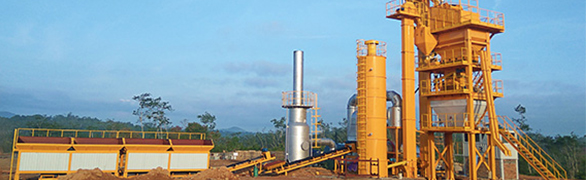
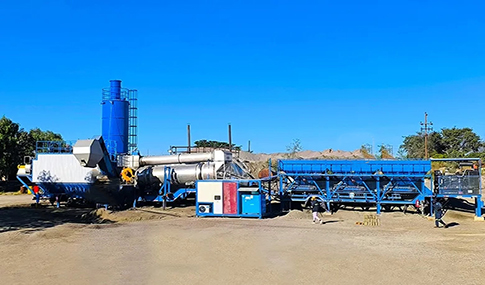
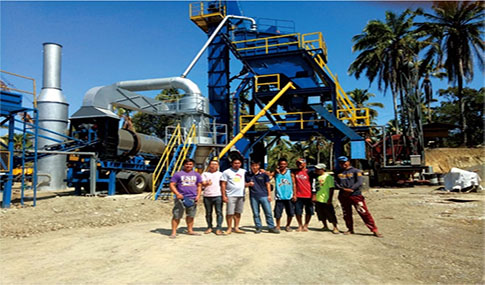
Many engineering practitioners will confuse the process logic of continuous and batch mixing plants, and the core difference between the two lies in whether the material production is "uninterrupted continuous flow" or "a batch cycle".
Batch mixing station, will weigh and measure each batch of sand aggregate, asphalt and mineral powder separately, dry and lift them, then store them in hot bin through hot material screening, put them into mixing tank for forced mixing for a fixed time, discharge them after completion, and then start the next round of metering mixing cycle. The whole process has periodic pause.
The continuous mobile asphalt mixing plant abandons batch cycle logic and relies on calibrated frequency conversion feeders, belt scales and mass flow meters to complete the continuous proportioning of various raw materials. Cold aggregates of different specifications are continuously conveyed into the rotating drum, drying and heating are completed inside the drum, asphalt and mineral powder are continuously metered in synchronization, mixing is completed synchronously in the drum (or external continuous mixer), and the finished hot mix asphalt mixture is continuously discharged outwards. There is no batch waiting, hot material screening and intermittent weighing cycle in the whole process.
The whole process can be broken down into five consecutive processes. First, cold aggregate ingredients, sand, gravel, crushed stone and other aggregates of different specifications are loaded into independent cold bins, frequency conversion vibration or belt feeder, continuously output materials according to the mixture design ratio, summarized on the summary belt, belt scale real-time monitoring conveying flow into the drum. The second is drying and heating process, the aggregate enters the inclined rotating steel drum, and the burner outputs high temperature flue gas to dehydrate and heat the stone. The equipment is divided into two structures: downstream and counter-current. The downstream mode stone and hot flue gas travel in the same direction; the counter-current roller stone travels in the opposite direction to the high temperature flue gas, with higher heat exchange efficiency, lower energy consumption and better flue gas emission performance. It is the mainstream preferred configuration in the current market. The stone is heated by rollers, and the temperature is stably controlled at 140‑180℃, meeting the construction temperature standard of hot mix asphalt.
The third is continuous mixing. The classic drum integrated equipment directly sprays liquid asphalt through nozzles in the mixing area in the second half of the drum, simultaneously inputs mineral powder and various admixtures, and relies on the continuous rolling of the plate inside the drum to allow the asphalt to completely cover the aggregate surface. The new generation models adopt external continuous forced mixing scheme. After drying, the stones are transported to independent double-shaft continuous mixing tank, which relies on mechanical forced mixing by blades to further improve the mixing uniformity. The whole set of proportioning is regulated by PLC control system in real-time closed-loop, and the feed speed of each raw material is dynamically corrected according to the readings of belt weigher and flowmeter to ensure the stability of mixture proportioning.
The fourth is dust removal and environmental protection treatment. The high temperature exhaust gas discharged from the drum is first subjected to primary cyclone dust removal, and then sent to the pulse bag filter to capture fine dust. The collected stone powder can be mixed back into the production as mineral powder, effectively reducing solid waste, and controlling the dust emission within the compliance range. Finally, the finished hot asphalt mixture is continuously discharged, sent to a short-distance thermal insulation buffer bin through a discharge belt, and directly loaded and transported to the paving construction site. As long as raw materials continue to be supplied, the entire set of equipment can produce stably for hours without interruption, without the need to start and stop frequently waiting for unloading.
Thanks to the structure of no towering hot material screening tower, the whole set of equipment is integrated on the trailer and modular chassis, without complex concrete foundation, the power and fuel can be commissioned and put into operation on the flat site, and the disassembly and transfer can be completed within 1‑2 days, perfectly adapting to the construction scenario with frequent changes of project points.
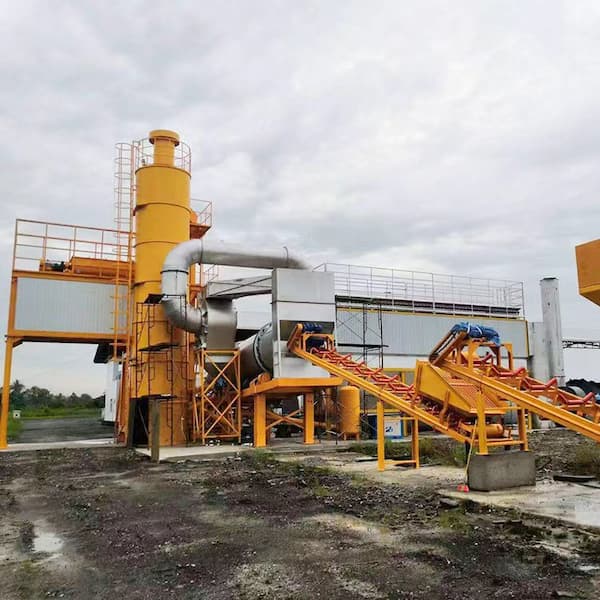
A complete continuous mobile asphalt mixing plant, all functional units are modular trailer design, can be transported as a whole trailer or sub-module transfer, the whole equipment is divided into eight core systems, each system collaborates to complete the whole process from raw material loading to finished product discharge.
The cold aggregate supply system is generally configured with 3‑5 cold bins to store sand and gravel aggregates of different particle sizes respectively. The bottom of each bin is equipped with a variable-frequency driven belt or vibrating feeder to control the discharge flow by variable frequency speed regulation to realize the proportioning control under cold state. Most of the inclined conveyor belts are integrated with belt scales, which measure the total amount of aggregate conveyed in real time and feed back the data to the main control PLC, which is the first pass of the whole equipment ratio control. The cold bin module is installed on the mobile chassis as a whole, and can be transported as a whole during transition, greatly reducing the workload of disassembly.
Drying mixing drum host is the core unit of the whole set of equipment, long size inclined rotating steel drum, multi-layer copying plate is arranged in the drum, stone is repeatedly lifted by copying plate to form material curtain, maximizing contact with high temperature flue gas to improve heat exchange efficiency. The drum is divided into drying heating zone and mixing zone, and the burner is installed at one end of the drum to support diesel oil, heavy oil and natural gas dual fuel selection. Because of the energy consumption advantage of the counter-current drum host, the proportion of new equipment procurement is getting higher and higher. Some equipment rollers reserve RAP recycling feed openings, which can be mixed with up to 30‑35% of old asphalt milling materials to realize the recycling of old pavement materials.
The asphalt supply metering system comprises a thermal insulation heating asphalt storage tank, a heat transfer oil heating pipeline, a conveying pump, a Coriolis mass flowmeter and an injection nozzle. The thermal insulation and heating system of the storage tank ensures that the asphalt maintains a proper working viscosity, the mass flowmeter continuously measures the output flow of asphalt, and synchronously adjusts the pumping rate according to the mixing ratio to spray the high temperature asphalt into the mixing area at high pressure to ensure that the asphalt dosage is accurately controlled.
Mineral powder and additive supply system composed of mineral powder storage tank, screw conveying mechanism or pneumatic conveying unit, mostly using weight-loss continuous metering mode, stable supply of stone powder, cement, lime and other fillers; at the same time reserved interface, can add warm mixing agent, pigment and other solid and liquid additives.
Dust removal environmental protection system consists of primary cyclone dust collector, pulse bag dust collector, induced draft fan and ventilation pipeline. The exhaust gas of the drum is separated into large particles by cyclone device, and then enters the bag filter to capture fine particles. The collected dust can be recycled into the mixture. Compared with early water bath dust removal, bag dust removal has better environmental protection performance and is also the mainstream configuration for environmental protection acceptance of domestic projects.
Finished product discharge buffer storage system, including discharge conveyor belt and short-term insulation buffer bin. Continuous equipment is uninterrupted discharge, small insulation bin plays a buffer role, avoid equipment downtime caused by alternate waiting of the conveyor, and ensure production continuity; some models can also be equipped with larger capacity hot storage bins to meet the peak centralized feeding demand.
PLC automatic control system is arranged in the movable control shelter, integrating touch screen, temperature sensor, flow and weighing signal acquisition module. Operators monitor aggregate flow, asphalt flow, drum temperature and mixture discharge temperature in the shelter. The system can automatically adjust each feeding unit in real time according to preset proportion. It also supports production data recording and fault alarm. The high-configuration model also has remote Internet of Things monitoring capability.
Mobile chassis and auxiliary matching, each module configuration trailer chassis, hydraulic support legs, quick docking pipeline, quick cable connector. At the same time, RAP old material regeneration system, external continuous forced mixing host, heat transfer oil heating unit and other optional modules can be selected, and the configuration can be flexibly increased or decreased according to the project demand.
Compared with other asphalt mixing equipment, the core competitiveness of continuous mobile asphalt mixing plant comes from the dual advantages of continuous production process and modular mobile chassis, which can greatly reduce the comprehensive cost of equipment investment, production energy consumption, manpower management and transfer transportation under the adaptation scenario. At the same time, there are clear application boundaries. The specific advantages, limitations and selection points are classified as follows:
Continuous stable production, higher construction efficiency: equipment without batch mixing interval, can achieve uninterrupted continuous discharge, the same installed specifications under the actual hourly capacity is higher. It can provide stable material supply for long-term paving of highway, effectively avoid the problem of cold joint of pavement caused by paver waiting for shutdown, greatly improve the overall construction progress, and ensure the continuity of paving operation.
Flexible mobility, strong adaptability to the site: the equipment cancels the traditional high-rise hot material screening tower, the overall structure is compact, and the occupied area is small. Relying on the modular trailer design, there is no need to pour permanent concrete foundation, only need to level the site can be quickly put into production, 1-2 days can complete the disassembly and transfer. Especially suitable for mountain roads, remote county road network reconstruction, post-disaster emergency repair and other scenarios, production points can be arranged nearby, material transportation distance can be shortened, and quality problems such as mixture cooling and segregation can be eliminated.
Outstanding cost performance, lower comprehensive cost: under the same production capacity conditions, equipment procurement costs are 20%-50% lower than intermittent mobile mixing plants. The equipment structure is simple, the number of vulnerable parts is small, the daily operation and maintenance difficulty and maintenance cost are lower; the continuous and stable operation mode avoids the heat loss caused by frequent start and stop, and the comprehensive production energy consumption can be reduced by 15%-30%. It is extremely friendly to the engineering team with multiple site circulation and limited budget, and the economic benefit of the whole life cycle is remarkable.
Simple operation, good green construction: no complex hot material screening system, simple equipment operation logic, short operator training cycle, with PLC automatic matching control system, can achieve automatic and stable production, daily operation and maintenance workload is small. At the same time, the equipment generally supports 30%-35% of RAP old asphalt recycled materials, realizing the resource utilization of waste pavement materials, meeting the requirements of green construction policies.
The mixing accuracy of continuous mixing plant completely depends on the measurement and control of cold material end, lacking the secondary correction process of hot material screening, the mixture quality is easily affected by the cold aggregate grading and moisture content fluctuation, and the mixing deviation is easy to occur when the raw material stability is insufficient. The equipment is suitable for long-term production conditions of a single formula, and it is impossible to quickly switch multiple mixture ratios. The flexibility of the formula is far less than that of the batch mixing station. For airport runway, high-grade special pavement and other projects with strict standards for mixture accuracy and uniformity, continuous equipment cannot meet the construction requirements, and intermittent mixing equipment should be preferred.
The equipment accurately adapts to road construction projects withlarge output, fixed single mixture formula and frequent multi-point transfer. It is a cost-effective choice for rural road network, ordinary trunk highway, emergency repair and other projects. If the project has frequent switching ratio, large fluctuation of raw materials and extremely high pavement construction precision standard, it is not recommended to select continuous mobile asphalt mixing plant.
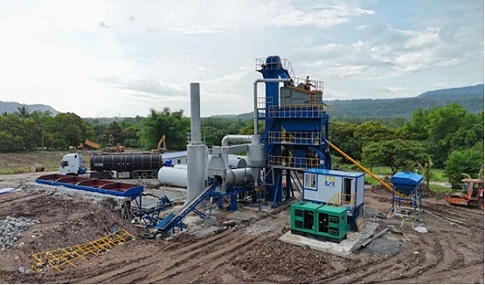
In the selection of asphalt mixing equipment, the selection of continuous mobile mixing plant and intermittent mobile mixing plant is the core problem of engineering procurement. The two have significant differences in production process, quality control ability, mobility, cost and applicable scenarios. The specific all-round comparison is as follows:
|
contrast dimension |
Continuous mobile asphalt mixing plant |
intermittent mobile asphalt mixing plant |
|
manufacturing technique |
Cold end to complete the material proportioning, no hot screening process, relying on belt scales, flow meters to dynamically adjust the material supply, uninterrupted continuous discharge throughout the process, no production interval |
Batch cycle operation is adopted. After the dried aggregate is lifted, hot screened and stored in different warehouses, it is weighed and stirred independently batch by batch. There is a short standby interval after each batch is discharged. |
|
qc quality control |
Mixing accuracy depends on cold aggregate stability, unable to offset fluctuations in incoming aggregates, frequent switching of mixture formula complicated operation |
With hot screening correction link, it can offset the error of aggregate incoming material, the mixture quality stability is very strong, and different mixture formulas can be quickly switched. |
|
Equipment structure and mobility |
Compact structure, no towering mixing tower, high modular integration, fast disassembly and transportation speed, strong site adaptability |
Equipped with high-rise mixing tower structure, complex equipment, mobile version disassembly process complex, long relocation cycle, transition difficult |
|
comprehensive cost |
Low equipment purchase price, simple structure, less wear parts, lower overall operation and maintenance, energy consumption and transition costs, high cost performance |
Equipment procurement, maintenance and energy consumption costs are higher, and long-term operation comprehensive investment is relatively large. |
|
Applicable engineering scenarios |
Suitable for scenarios such as common national and provincial trunk lines, rural road networks, long-term construction of mine roads, road emergency repair, etc.; suitable for projects with scattered points, limited budget and long-term use of fixed mixture formula |
Suitable for high-precision projects such as airport runways and high-standard special pavements; suitable for projects with large fluctuations in raw materials, frequent switching of mixture ratios, and strict quality control |
In general, both types of equipment can produce qualified asphalt mixture. The final construction quality not only depends on the type of equipment, but also closely related to the field raw material control, equipment commissioning accuracy and professional level of operators.
The continuous mobile asphalt mixing plant is divided into two mainstream technical routes: traditional drum integrated mixing (classic drum mixing), and drying drum + external double-shaft continuous forced mixing. Both schemes belong to continuous production. The core difference is the location and mixing mode of mixing, which directly affects the uniformity of mixture, flue gas emission and equipment cost.
Drum mixing is a classic drum mixing scheme in which drying, heating and mixing all take place inside the same rotating drum. The stone is dried and heated in the front part of the drum, and then moved to the mixing area in the second half of the drum. Asphalt is sprayed and mineral powder is added at the same time. The coating mixing is realized by the rolling gravity of the rotating plate of the drum. The whole set of equipment has few parts, the whole machine is the most compact, the cost is the lowest, and the mobility is the strongest. The asphalt spraying position of the downstream drum mixing equipment is located in the high-temperature flue gas channel, which has the problems of asphalt aging due to heating and high asphalt flue gas emissions; after the structure of the countercurrent drum is optimized, the mixing area avoids high-temperature flue gas, alleviating this defect to a certain extent. Suitable for budget priority, common standard mixture-based, the pursuit of the ultimate convenience of the transition project.
External continuous forced mixing scheme: stone is only dried and heated in the drum, hot stone is discharged and transported to independent external double-shaft mixing tank, asphalt and mineral powder are all added in the external mixing tank, and the mixing is completed by mechanical forced shearing of blades. Drying and stirring are physically separated, asphalt completely avoids high temperature flue gas of drum, asphalt aging is less, VOC emission of asphalt flue gas is lower; mechanical forced stirring makes aggregate asphalt coating more uniform, uniformity of finished mixture is greatly improved, and mixture quality can approach intermittent station level. The cost is that the equipment adds a set of independent mixing host and material transfer mechanism, the complexity, weight and procurement cost of the whole machine increase, and the blades and lining plates belong to wearing parts during maintenance and need to be replaced regularly. It is suitable for projects with higher requirements on mixing uniformity and environmental emission, and hopes to obtain mixture quality closer to batch station under continuous production mode.
The rated capacity of continuous mobile asphalt mixing plants on the market is very large, and the mainstream rated capacity of mobile trailer versions ranges from 20t/h to 160‑200t/h. Different capacities correspond to completely different engineering positions.
20‑60 tons per hour belongs to small models, mostly used for county rural road maintenance, pit repair, emergency rescue, small parking lot projects;60‑120 tons per hour belongs to medium-sized main models, municipal road reconstruction and expansion, ordinary national highway provincial road projects are most used, and it is also the specification with the largest market possession;120‑160t/h large-scale mobile continuous station, facing long-distance paving of high-grade highways, while still retaining modular relocation capacity; Some high-end models can achieve a capacity of nearly 200t/h, mainly serving large-scale infrastructure projects.
Many purchases are easy to see only the nameplate rated output. Here, it is necessary to pay attention to: the rated capacity marked on the equipment sample is obtained by testing under ideal conditions such as aggregate moisture content within 3‑5%, normal temperature environment, standard discharge temperature and full load. The actual effective production at the construction site is often discounted. Aggregate moisture content is the first major factor affecting the actual production capacity, the higher the moisture content of stone, drying needs to consume more heat, directly reduce the actual output of equipment; secondly, environmental temperature, altitude, RAP recycled material mixing ratio, burner operating conditions, operator management level, will change the actual output.
When calculating the project demand, it is necessary to calculate the tonnage of asphalt mixture required per day in combination with the total volume of the project, and calculate it according to the effective production of 8‑10 hours per day. At the same time, reserve 15‑20% capacity redundancy to offset the loss of site working conditions. Do not just select equipment at the peak of the project. For example, a rated 60t/h equipment, effective operation 8‑10 hours a day, the actual output of about 480‑600 tons;100‑120t/h equipment daily output can reach 800‑1200 tons, 160t/h model daily output of about 1280‑1600 tons. Continuous equipment because there is no batch pause, the same rated capacity conditions, the actual daily total output is often higher than intermittent equipment.
With the comprehensive advantages of nearby construction site layout, rapid production, continuous discharge and controllable cost, the equipment has been widely used in various infrastructure projects in China and exported to overseas developing countries.
During the construction and maintenance of expressways and national and provincial trunk linesand long-term paving construction, the equipment can be transferred forward along with the construction working surface to shorten the transportation distance of hot mixture and ensure the stable temperature of mixture on site. Road cover, widening, preventive maintenance works, long-term stability of mixture formula, continuous mobile station can continue to feed pavers, to ensure uninterrupted paving operations.
County and rural road network upgrading and reconstruction, county project construction points scattered, each construction site construction period is not long, if the construction of fixed mixing plant, investment return is difficult to cover; long-distance procurement of asphalt mixture, high transportation cost and easy to occur temperature segregation. Continuous mobile mixing station can be quickly transferred from one township construction site to the next township for nearby production, which is a sharp tool for rural road network construction.
Infrastructure projects in mountainous and remote areas, lack of ready-made asphalt mixing stations in remote areas, poor logistics conditions, and great difficulty in long-distance transportation of asphalt mixture. The mobile continuous station has low requirements on the site, and only needs to level the open space to carry out production on the spot, so as to solve the material supply problem of road construction in remote areas.
Road emergency repair works, flood, geological disasters damaged roads, need to quickly repair and restore traffic, continuous mobile station disassembly and debugging speed is fast, can produce hot mix asphalt mixture in a very short time, quickly complete road repair, minimize traffic interruption time.
Municipal engineering, industrial park, port factory roads, urban road night maintenance construction, equipment can be temporarily placed in the city idle open space, night production, reduce long-distance freight to urban traffic interference; industrial park, logistics park internal roads, parking lot large area pavement, also suitable for such equipment.
Of course, there are also unsuitable scenarios for equipment, such as airport runway and high-standard special pavement. The project needs to frequently switch the working conditions of various mixture ratios. Intermittent mixing stations are preferred to avoid quality risks.
.png)
Continuous mobile asphalt mixing plant belongs to large-amount engineering equipment investment. The selection cannot be compared with the equipment quotation in a single way. It needs to be comprehensively judged in combination with the enterprise business mode, construction conditions, raw material conditions, etc. to comprehensively match the actual needs of the project. The following are the systematic and classified professional selection points, covering the core selection of all dimensions:
The primary core of selection is to judge whether the equipment process is suitable for its own construction business, and check the adaptability from three dimensions: mixture formula, equipment transfer demand and raw material stability. Continuous mixing plant is suitable for long-term use of fixed mixture formula, high-frequency transition construction, and cold aggregate grading, stable and controllable moisture content of the project. If there are frequent mixture formula switching, large fluctuation of raw materials and extremely high requirements for pavement construction accuracy in the business scenario, continuous equipment adaptability is poor, intermittent asphalt mixing plant shall be preferred to avoid construction quality hidden danger and equipment adaptation problem from the source.
Accurately calculate the required capacity of equipment in combination with the actual project volume to avoid insufficient capacity overload operation or excess capacity resource waste. According to the total construction amount of the project and the effective daily construction time, calculate the daily hourly demand of asphalt mixture, and reserve 15%-20% capacity redundancy to offset the capacity loss caused by complex site conditions such as high moisture content of stone, low temperature and high altitude. It is strictly prohibited to select the type according to the peak demand of the project, otherwise the equipment will be overloaded for a long time, which will greatly increase the failure probability and shorten the service life of the equipment. At the same time, transportation conditions must be taken into account. Large-capacity equipment is larger in size and weight. It is necessary to confirm the local trailer traffic and over-limit transportation approval requirements in advance to avoid the problem of transfer transportation.
According to the annual transition frequency of the equipment, the mobility performance of the equipment is matched according to the target. For multi-point, short-cycle and high-frequency transition construction projects, highly integrated models with few trailers, hydraulic outriggers and rapid pipeline docking shall be preferred to minimize disassembly, commissioning and production cycles and improve construction efficiency. If the equipment can be continuously used for several months on a single site and the transition frequency is low, the mobile performance requirements can be relaxed appropriately, giving priority to the equipment production capacity, core configuration and procurement cost, and balancing the equipment practicality and cost performance. At the same time, it is necessary to strictly comply with local road transportation laws and regulations, confirm that the size and weight of equipment modules comply with regulations, and prevent the transfer approval from being blocked.
Combine construction standards, budget and environmental requirements to select the appropriate mixing process. For projects with limited budget, only undertaking ordinary standard asphalt mixture construction, and pursuing extreme convenience of transition, priority shall be given to drum integrated counter-current mixing model with higher cost performance and more compact structure to meet the requirements of conventional road construction. If the project has higher requirements on mixture mixing uniformity and environmental emission, it is hoped that the finished product quality will approach the batch equipment standard, and higher procurement and operation and maintenance costs can be accepted, the external double-shaft forced continuous mixing model will be preferred to effectively reduce asphalt aging, reduce VOC emission and improve the overall quality of mixture.
Comprehensively verify the core configuration of the equipment to ensure stable operation of the equipment, compliance with standards and adaptation to multiple construction requirements. The drying drum shall preferably adopt the counter-current structure with higher thermal efficiency and lower energy consumption; the burner shall match the local energy conditions and support the adaptation of diesel oil, heavy oil, natural gas and other fuels; the dust removal system shall be equipped with pulse bag dust removal to ensure that the filtration effect meets the local environmental protection emission standards. The control system shall be equipped with a complete PLC automation system, support real-time closed-loop adjustment, data recording, fault warning, focus on verifying the brand and calibration scheme of core metering components such as belt scale and asphalt mass flowmeter, so as to ensure accurate proportioning. For projects requiring recycling of used materials, it is necessary to confirm that the equipment is equipped with a complete RAP recycling system, and check the materials of wearing parts such as copying plates, stirring blades and lining plates to reduce the frequency and cost of later maintenance.
The stability of long-term operation of equipment is inseparable from perfect operation and maintenance and after-sales support, which is the key hidden index of selection. Priority shall be given to checking the fuel energy consumption parameters of the equipment. Under high-quality working conditions, the fuel consumption of standard equipment per ton of mixture shall be stable at 5.5-7kg. The energy consumption index directly determines the later operation cost. At the same time, focus on the manufacturer's regional after-sales service capability, including local service network coverage, spare parts supply cycle, equipment commissioning and operator training services, complete machine warranty clauses, etc. Do not only pay attention to bare metal purchase price, ignore after-sales short board, avoid late equipment failure, spare parts shortage caused by project shutdown, resulting in high hidden economic losses.
Equipment selection needs to account for the comprehensive cost of the whole life cycle, rather than a single comparison bare metal quotation. The comprehensive cost shall cover all expenses such as equipment purchase cost, land and sea transportation cost, import and export tariff, on-site commissioning cost, wearing parts replacement, fuel energy consumption and multiple transfer transportation. At the same time, do a good job in market research, ask the manufacturer for real construction cases under the same working conditions, refer to the feedback from the actual equipment use of peer contractors, comprehensively evaluate the practicality, stability and cost performance of the equipment, and finally select the equipment model suitable for its own business, with the best cost performance and the highest long-term profit.
.jpg)
The price of continuous mobile asphalt mixing plant equipment is affected by multiple factors such as production capacity, mixing process, automation level, environmental protection configuration, and brand origin. Domestic equipment dominates the market, and the price of equipment of the same specifications from European and American brands will be 1.5‑3 times higher. The following is the FOB ex-factory reference dollar price (2025‑2026 market quotation), and a number of additional fees will be added to the final landing use.
20‑40t/h small mobile continuous station, price range 50000‑140000 USD, basic drum mixing configuration, mostly used for maintenance and small engineering; 40‑60t/h entry-level mainstream model, price 80000‑180000 USD, widely used in domestic engineering projects; 60‑80t/h middle-end model, 100000‑220000 USD, giving consideration to production capacity and mobility; 80‑120t/h medium-and large-sized equipment, more than 130000 USD, high-equipped automatic bag dust removal, RAP regeneration configuration price upward fluctuation; 120‑160t/h large mobile continuous station, more than 180000‑350000 USD, belonging to high-capacity mobile equipment.
Configuration upgrade will significantly increase the price of equipment, external forced mixing host, high-power multi-fuel burner, high-grade bag dust removal, full RAP regeneration system, remote Internet of Things monitoring, each additional option, equipment quotation will rise.
In addition to the equipment payment, the procurement budget also needs to reserve various hidden expenses: equipment sea and land transportation costs, import and export customs clearance; on-site commissioning and installation, operator training; wearing parts package; part of the supporting asphalt storage tank, heat transfer oil system, if not standard, also need to be purchased separately. Although mobile equipment does not require large-scale concrete foundations, the site is simple and flat, and the power supply is connected, which also needs to be included in the project cost.
Although second-hand equipment can reduce the initial purchase investment, it is necessary to carefully evaluate the remaining life of the equipment, measure the wear degree of the parts, the difficulty of spare parts supply, and the risk of frequent failures of second-hand equipment. It is not recommended for non-professional users to choose blindly.
The continuous mobile asphalt mixing plant itself has good energy efficiency advantages, but the differences in raw material control, equipment operation and daily maintenance on the construction site will cause a gap of 10%-30% between equipment energy consumption and actual output. Through systematic and classified optimization and control, the actual production capacity of equipment can be effectively improved, fuel consumption can be reduced, downtime can be reduced, and the economic benefits of construction can be comprehensively improved. Specific optimization measures can be divided into five categories:
Stone drying is the core link of energy consumption of equipment, and the moisture content of aggregate directly determines the production energy consumption and discharge efficiency, which is the most cost-effective optimization method. The data show that for every 2% decrease in stone moisture content, the burner energy consumption can be reduced by about 20%. Rainproof cover shall be provided for sand and gravel piles during construction, drainage slope shall be set on the ground of material yard for rapid drainage, loader shall take dry materials from the upper layer of material piles first, and high-humidity aggregate shall be avoided from entering the loader. This method does not require additional investment, which can not only greatly save fuel, but also stabilize the discharge temperature of the mixture and improve the actual production capacity of the equipment.
Focus on core equipment such as burners and drying drums, and do regular debugging and upgrading to reduce energy consumption from the hardware level. Before the construction season, it is necessary to overhaul the burner comprehensively, optimize the air-fuel ratio, and reduce the loss caused by incomplete combustion of fuel; regularly check and replace the roller plate to ensure that the stone rises to form a uniform material curtain and improve the heat exchange efficiency; add an insulation layer to the roller, which can reduce the heat dissipation loss of the cylinder by 5%-10%. At the same time, frequency conversion drive system is installed for induced draft fan and drying drum motor to dynamically adjust rotation speed according to production conditions to eliminate ineffective energy consumption; under the premise of meeting the safety of bag filter to prevent dew condensation, the exhaust gas temperature is reasonably controlled to avoid heat waste. In addition, it can be equipped with multi-fuel burner, flexible switching of economic fuel, matching with asphalt storage tank, heat transfer oil pipeline full insulation design, reduce heat loss, reasonably mix RAP recycled old asphalt material when conditions permit, and further reduce overall energy consumption by virtue of the characteristics of recycled material without high temperature drying.
Frequent start and stop of equipment will produce 20%-35% additional fuel consumption, stable and continuous production conditions are the key to cost reduction and efficiency. The production scheduling of the project needs scientific planning, relying on the buffer insulation bin supporting the equipment, filling the gap between the alternate loading and unloading of the material truck, and ensuring the uninterrupted operation of the equipment to the maximum extent. If special circumstances must be started and stopped, it is necessary to adopt low load mode operation to effectively reduce waste generation and energy waste. At the same time, the discharge temperature shall be strictly controlled to avoid excessive heating of the mixture on the premise of conforming to the road construction specifications. For every 5-6℃ decrease in discharge temperature, 2%-3% fuel can be saved. With warm asphalt mixing technology, heating energy consumption can be further reduced and the operation environment can be optimized.
Accurate proportioning is the core to ensure mixture quality and stable production efficiency. Belt weigher, asphalt mass flowmeter and other core metering components are prone to measurement drift due to long-term equipment vibration and site dust. Sensors shall be calibrated regularly according to the frequency of use. Make full use of the advantages of PLC automatic control system of the equipment, monitor the core data such as aggregate flow, asphalt consumption, equipment temperature, etc. in real time, dynamically correct the proportioning parameters, and timely check the abnormal operation of the equipment. High-end models can be equipped with remote Internet of Things monitoring system to realize early warning of faults and avoid capacity loss and quality problems caused by unbalanced ratio and equipment failure.
Perfect operation and maintenance system and reasonable site layout can greatly reduce unplanned downtime. It is necessary to establish a wearing parts account on a daily basis, regularly check the drum plate, burner nozzle, dust filter bag, transmission belt, seals and other vulnerable parts, store key spare parts on site, and quickly respond to faults; regularly clean the coking accumulation inside the drum to avoid material accumulation damaging the heat exchange condition; timely maintain the bag dust removal system to prevent the equipment resistance from increasing and the production capacity from being limited. At the same time, optimize the layout of the material yard, reasonably plan the cold storage bin, material storage yard and loading area, shorten the working distance of the loader, reduce the time spent on material transfer, and eliminate the problems of equipment speed reduction and shutdown caused by the backlog of finished materials and poor connection of vehicles.
Through the above all-round optimization, the fuel consumption of the equipment can be stably controlled at a high-quality working condition of 5.5-7kg/ton, the actual production capacity is infinitely close to the rated parameters of the nameplate, the unplanned downtime is greatly reduced, and the mixture ratio stability is significantly improved, which can effectively reduce the construction cost and improve the overall income of the project.
With the continuous mixing process of drum and modular trailer design, continuous mobile asphalt mixing plant has the outstanding advantages of strong mobility, stable production capacity and high cost performance in road construction scenarios with large output, fixed formula and frequent transfer. However, it has clear application boundary, and the quality of finished products depends on the stability of cold aggregate, which is not suitable for special pavement projects with frequent formula change and ultra-high precision. When selecting and purchasing, the engineering party shall abandon the single thinking of only looking at the production capacity and bare metal price, reasonably select the mixing process in combination with its own project type, raw material conditions and transition requirements, and calculate the comprehensive cost of the whole life cycle of the equipment. On the premise of standardizing operation and maintenance and optimizing production, this equipment can fully release its production capacity advantages, reduce cost and increase efficiency, and will continue to play an important role in urban and rural road construction, highway maintenance, emergency repair and other infrastructure scenarios in the future.