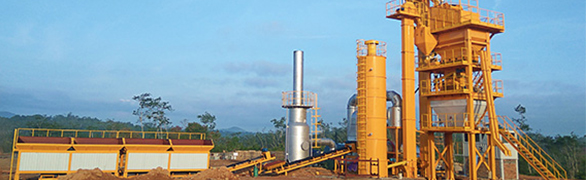
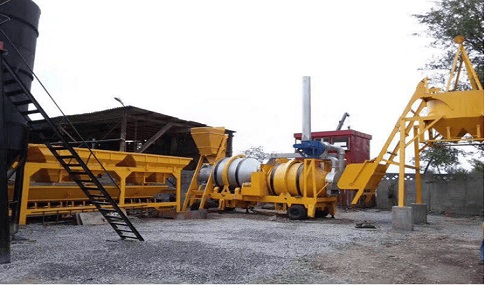
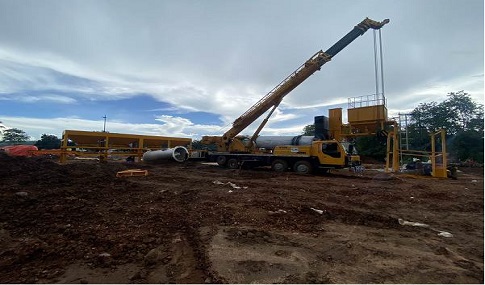
Continuous asphalt drum mixing plant, also known as drum asphalt mixing plant, continuous asphalt mixing plant, is the mainstream hot mix asphalt mixture (HMA) production equipment in the field of road infrastructure.Its core is different from the batch production mode of traditional batch mixing station. It adopts single drum integrated continuous operation technology, and completes the processes of aggregate drying, heating, asphalt mixing and finished product discharging synchronously in the rotating drum. There is no production interruption and batch interval in the whole process. It is the core main equipment for large-scale and normal pavement construction.
The traditional batch asphalt mixing plant adopts discrete operation step by step, which needs to independently complete the procedures of aggregate weighing, screening, drying, stirring and unloading, etc., with fixed periodic pause in production, limited upper capacity and complicated equipment structure.The continuous asphalt drum mixing station relies on the integrated drum structure to form a closed-loop production line of feeding, drying and heating, asphalt mixing and finished product discharge. The whole process is fully automatically and accurately controlled by the computer system, which stably controls the aggregate proportion, asphalt dosage, discharge temperature and mixture uniformity, and the finished product quality is extremely consistent.
.jpg)
Compared with traditional batch equipment, continuous asphalt drum mixing station relies on exclusive continuous production process, simplified structure design and efficient operation logic. It has all-round advantages in seven dimensions: capacity efficiency, cost control, site adaptation, transfer construction, finished product quality, energy conservation and environmental protection, and operation and maintenance difficulty. It is widely used in large and medium-sized infrastructure projects and long-term pavement maintenance projects. The core advantages are as follows:
Uninterrupted continuous high production, suitable for large-scale construction: no batch start-stop interval throughout the equipment, to achieve continuous feeding, mixing, discharge of materials, conventional capacity coverage of 20 - 200 + TPH, high-end large-scale models capacity up to 400 TPH or more.Completely avoid intermittent equipment batch switching, equipment start-up and shutdown brought about by the production capacity window period, can continuously and stably supply sufficient mixture for large-area pavement paving, perfectly adapt to high-speed reconstruction and expansion, urban trunk road renovation, airport yard pavement and other key projects with tight construction period and large consumption, effectively ensure the continuity of construction progress.The mainstream manufacturers in the industry standardize the classification of equipment according to the airflow direction of the drum, the movement form of the equipment, the capacity specifications and the functional configuration.The thermal efficiency, environmental protection performance, regeneration capacity and construction adaptation scenarios of different models are significantly different, which can accurately match the personalized construction requirements of various engineering projects. The specific categories are as follows:
Downstream asphalt drum mixing station: aggregate feed direction is consistent with hot air flow direction of burner, burner is arranged at feed end.The equipment has simple structure, low cost, extremely low failure rate and convenient operation and maintenance. The mainstream production capacity is 20 - 160 TPH. It is a common model for small and medium-sized construction units. It is suitable for projects with low requirements for energy consumption and recycled material utilization such as township roads, small municipal maintenance and low-grade road networks.The disadvantages are general heat exchange efficiency, high fuel consumption, general flue gas emission performance, and only 25% maximum mixing ratio of recycled asphalt (RAP), which is not suitable for high environmental protection and high regeneration demand projects.
Counterflow asphalt drum mixing station: aggregate traveling direction is completely opposite to high temperature hot air flow and flame direction, burner is arranged at the finished product discharge end, aggregate can make full use of drum waste heat exchange, heat exchange efficiency is greatly improved, fuel energy consumption can be reduced by 15%-25%.The mixing area of the equipment is far away from the open fire and high temperature area, effectively avoiding the aging of asphalt at high temperature, reducing the emission of smoke and dust, and excellent environmental protection performance.The recycled material has strong adaptability, with RAP mixing ratio up to 40%-50%, which is suitable for medium and large road engineering, Urban area environmental protection strict control construction and waste asphalt recycling projects. It is the mainstream upgraded model in the current market.
Double-drum/double-layer drum mixing station: it belongs to counter-current high-end upgraded model, adopts internal and external double-layer independent drum structure, the inner layer is dedicated to complete aggregate drying and heating, and the outer cavity is independently used for asphalt mixing operation. The two processes are divided into independent zones without interference.The thermal efficiency, mixing uniformity and recycled material processing capacity of the equipment are all at the top level in the industry. The finished product precision is high, the energy consumption is low, the emission is low, and it is suitable for high-standard projects such as high-grade highways and airport runways. The only short board is the complex structure and high equipment cost, which are mostly used for large-scale infrastructure projects of large-scale engineering enterprises.
Fixed mixing station: fixed installation on concrete foundation, stable structure of the whole machine, high upper capacity and strong operation stability, mainly medium and large capacity models, suitable for long-term fixed-point construction and large-batch mixture production projects, including new construction of expressway network, pavement of large municipal areas, fixed pavement maintenance base and other scenarios.
Removable/skid-mounted mixing station: modular skid-mounted structure is adopted, no complex infrastructure is required, periodic disassembly and transfer can be carried out according to construction demand, with small disassembly loss and convenient transfer, suitable for multi-area rotation construction of regional engineering contractors and medium and long-term regional road network reconstruction projects.
Mobile/vehicle-mounted mixing station: the whole machine integrates trailer chassis, integrated disassembly-free design, convenient transfer, can be put into production on landing, construction flexibility is extremely high, perfect for remote mountain construction sites, multi-point scattered maintenance, temporary emergency paving and other short-term construction projects.
The industry divides the equipment into four specifications according to hourly capacity: small 15 - 40 TPH, suitable for rural roads and small plant pavement; medium 40 - 120 TPH, mainly municipal roads and conventional road network reconstruction; large 120 - 200 TPH, suitable for high-speed reconstruction and large-area municipal pavement; super large 200 - 400 TPH, meeting the needs of large-scale transportation hubs and large-scale infrastructure production.RAP recycled material system, mineral powder addition system, multi-fuel combustion system, bag dust removal environmental protection system, automatic intelligent control system, constant temperature hot material storage bin and other modules can be selected according to needs to adapt to different process standards and environmental protection construction requirements.
.jpg)
Relying on the core advantages of high yield, low cost, flexible transition, wide adaptability and simple operation and maintenance, this equipment is widely used in many fields such as road infrastructure, municipal maintenance, airport construction, industrial infrastructure, rural construction, green recycling construction, etc., especially suitable for pavement engineering projects requiring continuous mass production, long construction period, limited site and stable formula. It is the core equipment for asphalt mixture production in infrastructure industry.
Highway and expressway construction industry: core application field, accounting for about 70% of the overall application scenario, covering new construction and reconstruction projects of national and provincial expressways and national and provincial highways, sustainable supply of large quantities of high-standard asphalt mixture, and ensuring continuity and stability of long-distance pavement paving.
Municipal urban and rural infrastructure industry: new construction and maintenance projects adapted to urban main and secondary roads, residential roads, municipal squares and urban-rural connecting road networks.The equipment occupies a small area and has good environmental protection performance. It can meet the construction requirements of small sites in Urban area and strictly controlled environmental protection areas, and is suitable for urban normal road maintenance operations.
Airport and transportation hub construction industry: suitable for small and medium-sized airport runway, taxiway, apron pavement and renovation projects.The mixture produced by the equipment has high uniformity and good temperature stability, which can meet the strict standards of high bearing capacity and high flatness of airport pavement, and make up for the shortcomings of high cost and low utilization rate of large-scale intermittent equipment.
Industrial and logistics infrastructure industry: Widely used in industrial parks, logistics parks, port terminals, large-scale parking lot pavement, can meet the construction needs of wear-resistant pavement for heavy vehicles, high mass production efficiency, controllable construction costs.
Rural revitalization infrastructure industry: small and medium-sized mobile models have low cost, flexible transition, simple operation and maintenance, adapt to the reconstruction of low and medium-level road networks such as township industrial roads and village access roads, and accurately match rural decentralized, small-batch and multi-point construction scenarios.
Road maintenance and recycling industry: counter-current and double-cylinder models equipped with RAP recycling system can efficiently recycle waste asphalt pavement materials, adapt to road milling and resurfacing, disease repair, road widening and other recycling projects, taking into account construction quality and green environmental protection requirements.
The equipment adopts fully automatic assembly line integrated production mode, from cold aggregate proportioning transportation, dynamic weighing, drying and heating, asphalt spray mixing, tail gas dust removal purification to finished product discharge and storage, the whole closed-loop continuous operation, no batch pause, no material retention, stable and controllable production accuracy, the complete production process is as follows:
Cold aggregate precise proportion transportation: The equipment is equipped with 4 groups of independent cold bins (2 - 5 bins can be customized), which store aggregates, sand and minerals of different particle sizes.According to preset proportioning parameters, the system accurately controls the blanking flow of various aggregates through variable frequency speed regulating gates and conveyor belts. Various aggregates complete preliminary mixing on the collection belt, and the pre-vibrating screen simultaneously removes ultra-large particle size impurities to ensure the uniformity of raw material specifications and lay the foundation for subsequent uniform mixing..jpg)
Core technical parameters of continuous asphalt drum mixing station
The technical parameters of equipment vary slightly with production capacity, model configuration and manufacturer's process. The mainstream models in the industry adapt to the general construction acceptance standards at home and abroad.The following are the core parameters of 15 - 425TPH models, which are suitable for domestic DM series and imported EX series general equipment. The benchmark working condition is aggregate moisture content of 3%.
Equipment selection directly determines construction efficiency, production cost, finished product quality and long-term operation and maintenance benefits. Most purchasers are easy to fall into various purchase errors due to lack of professional experience, resulting in poor battery life, high energy consumption, frequent failures and substandard production capacity after equipment is put into production.Combined with the practical operation experience of industry procurement, sort out eight high-frequency misunderstandings and precise pit avoidance schemes, assist the purchaser to select scientifically and control the comprehensive cost.
Mistake 1: Select models only based on theoretical peak production capacity, ignoring actual effective production capacity: Most purchasers directly refer to the manufacturer's nominal peak production capacity to select models, ignoring the impact of actual working conditions such as aggregate moisture content, weather environment, vehicle connection, and equipment loss.In actual construction, the effective production capacity of equipment is 15%-30% lower than the theoretical value, which is prone to large equipment idle waste, soaring energy consumption, or small equipment overload operation, frequent failures, delay in construction period, etc.
Mistake 2: blindly pursuing the lowest purchase price and ignoring the comprehensive use cost: low-cost equipment generally has problems such as insufficient wall thickness, poor material quality of lifting plate, low accuracy of burner, simple control system, and cutting corners in insulation layer.Although the initial purchase cost is low, the long-term fuel consumption is high, the wearing parts are frequently damaged, the downtime failure is frequent, and the subsequent maintenance, energy consumption and delay cost far exceed the equipment price difference.
Mistake 3: Neglecting after-sales support and spare parts supply capacity: Continuous mixing station belongs to heavy continuous operation equipment, long-term operation needs regular replacement of wearing parts, professional adjustment and maintenance.Small manufacturers and trade middlemen do not have a perfect after-sales system, and cannot provide technical support and accessories in time after failure, which is easy to cause long-term downtime of equipment, delay in construction period and economic loss.avoid
Mistake 4: Ignoring environmental protection configuration and failing to adapt to local emission standards: At present, environmental protection control of infrastructure is becoming stricter and stricter, simple dust removal equipment cannot meet the construction requirements of Urban area and environmental protection strictly controlled area, and risks such as emission exceeding standard, fine, shutdown rectification, etc. are easy to occur.Some purchasers simplify environmental protection configuration in order to save money, and upgrade and transform at high cost in the later stage, which is not worth the loss.
Mistake 5: The model process does not match the construction scenario: Common mismatching problems include: downstream models are selected for regeneration construction, fixed models are selected for multi-transition projects, and simple models are selected for high-standard projects, which directly lead to low regeneration utilization rate, high transition cost, substandard construction technology, low efficiency, etc.
Mistake 6: Omit field survey and technical parameter verification: Some purchasers only sign contracts based on manufacturer's quotation, fail to verify core parameters such as drum specification, insulation thickness, burner power, weighing accuracy, etc., fail to survey site power supply, land occupation and infrastructure conditions on the spot, and are prone to false equipment parameters, inconsistent size on site, insufficient power supply, failure to put into production, etc.
Mistake 7: Neglecting operator training and maintenance system construction: After the equipment selection is in place, there is no professional operator, no standardized maintenance process, easy to cause operation errors leading to imbalance, temperature out of control, equipment overload, and lack of maintenance will accelerate wearing parts aging, frequent failures, and greatly shorten the service life of the equipment.
Mistake 8: Docking middlemen instead of source manufacturers, rights and interests are not guaranteed: purchasing through pure trade middlemen, middlemen have no production, research and development, after-sales capabilities, easy to appear equipment parameters do not match, accessories inferior, after-sales prevarication, warranty failure, delivery delay and other problems, equipment quality and procurement rights can not be guaranteed.
asphalt drum mixing station has become the core mainstream equipment of road infrastructure, municipal maintenance, rural revitalization and green regeneration projects by virtue of its comprehensive advantages of continuous high yield, low cost, wide site adaptability, flexible transfer, simple operation and maintenance, energy conservation and environmental protection.The construction enterprise comprehensively grasps the working principle of equipment, type classification difference, application scenario, core parameters and pit avoidance skills, accurately selects the type in combination with the project working conditions, standardizes the operation and maintenance, maximizes the production capacity advantage of equipment, stabilizes the production quality of mixture, effectively reduces the comprehensive construction cost, guarantees the construction progress and acceptance standard of various pavement projects, and provides solid equipment support for improving the quality and efficiency of infrastructure projects and stabilizing the compliance and stability.