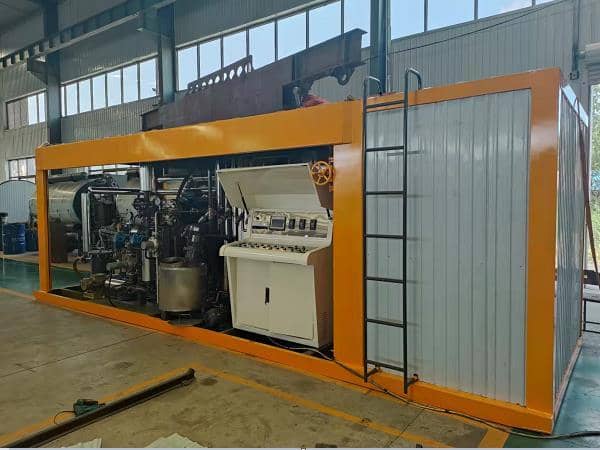
As the “Going Global” strategy continues to advance, we have steadily deployed complete asphalt mixing plants in the African infrastructure market. Recently, the company’s asphalt mixing plant project exported to the Democratic Republic of the Congo successfully completed installation and commissioning and officially commenced operations, providing robust equipment support for the development of the local road transport network and marking another successful case of overseas engineering services implementation.
Even before the equipment was shipped to the construction site in the Democratic Republic of the Congo, our technical team proactively provided advance support and conducted multiple rounds of in-depth coordination with the client. Given the many uncertainties inherent in overseas projects—such as time-zone differences in communication, logistics coordination, and complex on-site construction conditions—engineers provided comprehensive technical support throughout the process, including remote connectivity, detailed drawing reviews, and online Q&A sessions, to help the client coordinate and advance preparatory work for the installation of the asphalt plant. From reviewing equipment foundation drawings, pouring foundations, and positioning embedded parts, to planning the on-site construction layout, reserving utility connections, coordinating lifting equipment, and organizing and assigning work crews, clear technical guidelines are provided for each preparatory task to proactively identify potential risks. Meticulous and comprehensive preliminary preparations effectively shorten the construction readiness period after equipment delivery, laying a solid foundation for the rapid deployment and timely delivery of the entire system.
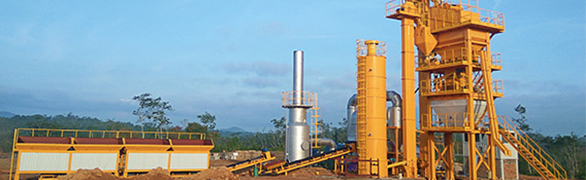
Upon the containers’ arrival at the project site, our resident engineers immediately proceeded to the location to coordinate and initiate the on-site installation of the entire equipment set. The unloading process strictly adheres to standardized operating procedures, with on-site guidance provided to local workers to ensure proper container unpacking and equipment offloading. Rough handling practices such as improper lifting and dragging are firmly prohibited to minimize the risk of impact, deformation, or damage to precision components and wear-resistant parts during transit. The removed components are inventoried, labeled, and arranged by unit module and functional category; a clear material ledger is established to facilitate subsequent retrieval and assembly, ensuring the smooth progression of lifting and mating operations. After completing material organization, the team proceeded in an orderly manner, in accordance with the established construction plan, to lift, align, and secure the core mechanical components—including the main unit, batching system, drying system, screening system, and dust collection system—steadily advancing the installation of the entire machine structure.
.png) |
.png) |
The project’s on-site operations team previously lacked hands-on experience with large-scale asphalt mixing plants of this type and was unfamiliar with the equipment’s process flow, assembly procedures, and safety management protocols. To ensure project quality and construction safety, our engineers will provide end-to-end oversight and real-time management of the entire installation process, ensuring that work is carried out in strict compliance with the manufacturer’s installation specifications and international site safety standards. During the assembly process, engineers provided hands-on demonstrations while simultaneously explaining key assembly procedures and risk control measures, balancing schedule, quality, and safety. By overcoming multiple challenges—such as limited material supplies and harsh environmental conditions at overseas construction sites—they successfully achieved high-quality, first-time installation of the equipment, stayed on schedule, and avoided delays caused by rework.
Following the completion of the mechanical mainframe installation and its successful specialized acceptance, the project immediately moved into the phase of electrical wiring, control system cabling, sensor calibration, and integrated machine commissioning. During the commissioning phase, engineers provided ongoing on-site, mentor‑style training. They disassembled the equipment for the customer’s designated operators and explained the interlocking logic of each module and the rationale behind parameter adjustments, enabling the operators to gain an intuitive understanding of the equipment’s operating principles. After the commissioning of the whole machine is completed, the team specially organized 1 systematic special training, focusing on the standard start-up and stop process of the equipment, formula setting, mixture quality control, inspection and replacement of wearing parts, daily lubrication and maintenance, rapid troubleshooting and a full set of on-site safety operation procedures, and reserved sufficient time to answer questions to help local operators establish a complete operation and maintenance knowledge system.
Subsequent equipment will undergo no-load trial runs and production trials with material, with continuous monitoring of key parameters such as discharge temperature, screening accuracy, metering stability, and dust emissions. Following multiple rounds of trial production and verification, all performance parameters of the equipment have met the design specifications. The asphalt mixture is discharged steadily with a uniform appearance, and the actual production capacity has successfully reached the target, fully satisfying the material requirements of local road construction projects.
The robust and reliable equipment quality, consistently dependable mix production performance, and timely, one-stop technical services throughout the entire project lifecycle have earned full recognition and high praise from the client team. The successful commissioning of this asphalt mixing plant will ensure a continuous supply of high-quality asphalt mixtures for new road construction and maintenance projects in the Democratic Republic of the Congo, helping to improve local transport infrastructure and enhance regional connectivity. Going forward, we will continue to deepen our presence in Africa’s overseas infrastructure market, consistently delivering high-performance mixing equipment and end-to-end technical services, thereby supporting the successful implementation of more international transportation projects with reliable products and expert service.
.png)